Demand for skilled labor in the construction industry hits all-time high
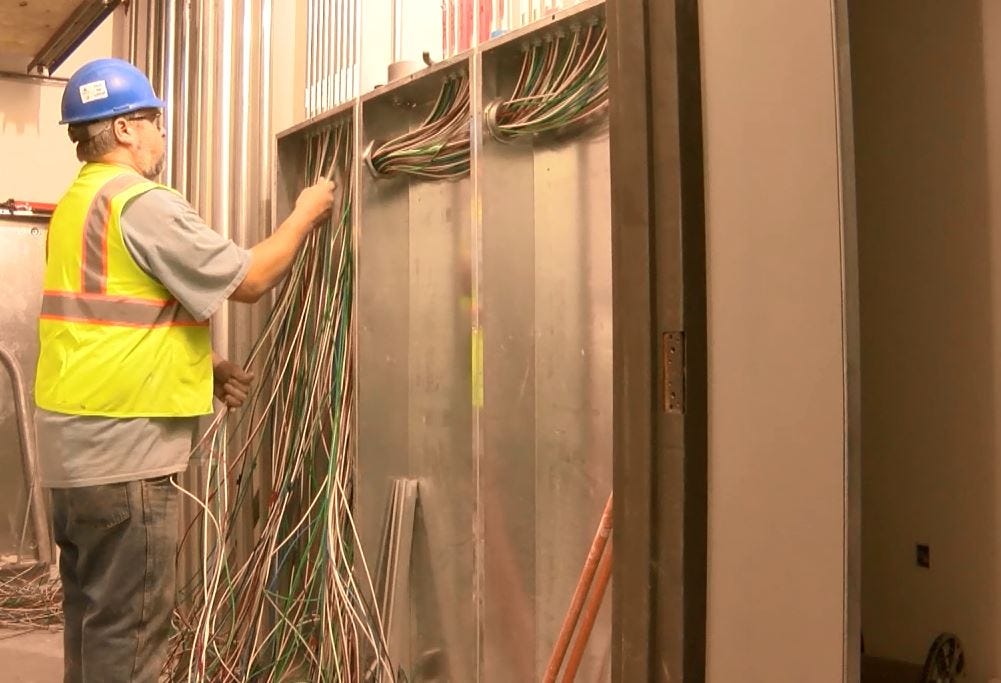
Nebraska’s low unemployment rate is causing problems for some industries especially for those who need a skilled workforce like construction.
With the growth of projects around the nation, many companies are struggling to fill the positions needed to fulfill project timelines, this according to a recent survey by the Associated General Contractors of America (AGC).
“Overall there is such a workforce shortage that timelines have gotten shorter to complete the project and the workforce has gotten less and so that is a difficult situation to accomplish everything that needs to be done on a certain timeline,” says Linette Butler, General Manager for BD Construction.
The amount of job openings has reached an all-time high with 52,000 jobs in January, and a 4.7 increase over the past year according to the survey.
Some might not see construction as a lucrative job, but those in the industry say it is a high paying career that usually gets overlooked.
“The construction industry on an average has much higher wages. The amount of education or training that you need to start in the industry is you know, just two years’ worth of college or just come right in and learn on site,” says Butler.
According to the survey, nearly 78% of construction companies reported having trouble filling positions and 68% said they expected hiring to continue to be difficult.
“We have a situation where we got a lot of our craft people that are coming to the end of their careers and retiring while at the same time we don’t have vast numbers of young people looking at construction as their career of choice,” explains Jane Petsch, Executive Director of the AGC Nebraska Buildings Chapter.
Petsch says a lot of it has to do with the applied technology classes that were cut out of high schools in the 80’s, 90’s and early 2000’s and a bigger push for 4 – year colleges was made.
“Young people just, they don’t know what construction has to offer in terms of a vast array of career options, career opportunities and also a vast array of different ways that you can get into the construction industry,” explains Petsch.
She says it created the perfect storm. Many schools have now implemented prep academies and stem programs to teach students these high pay, high demand, high skilled trade jobs, but she doesn’t expect the shortage to end anytime soon – saying it would take approximately another 7 – 10 years to fill the gap.
Another problem, small businesses that lack the knowledge to bid for the big projects.
“They don’t feel comfortable enough reading the blueprints, they don’t know how to write the bids they don’t know if they are charging too much or not enough, some of them are not even making enough,” says Griselda Rendon, REAP Loan Specialist with the Center for Rural Affairs. “The other challenge is the language. Most of them understand the English language, but they don’t feel comfortable speaking it.”
In order to bring that knowledge to small businesses agencies such as Nebraska Enterprise Fund, Nebraska Extension, REAP and experts in the industry are hosting a five – week training workshop.
“It gives them that opportunity to know what is required and how to make that move. And so in this workshop for example we’ll cover a lot of different topics; including just the basics of blueprints, reading contract specs, what they are going to need as far as insurance and bonding and how that will work and then some legal requirements of it too,” says April Myers, Business Development Director with Nebraska Enterprise Fund.
She says the industry tends to get a bad rep, but workers are very skilled at what they do even without post-secondary education.
“Sometimes it can have a stigma that if you work in a construction industry you are uneducated or you don’t have a scaling, that’s not necessarily the case,” says Myers. “I know we’ve encountered and I’m sure you have too, there’s lots of people that work in the industry that maybe haven’t had any post-secondary schooling that are still very good at what they do.”
Rendon says this also allows them exposure to those big companies.
“By exposing them to those bigger construction companies, exposing them to other small businesses I think that’s going to create that network and that comfort in them and they are going to push themselves,” says Rendon.
The top job openings currently highlighted in skilled– craft are welding, carpentry, plumbing and electrical.
“Those are all high paying, good benefits type career jobs that you can get into without a 4 year degree,” says Petsch.
She says many are career choices that can provide economic stability for a family without accruing student debt.
The workshop is free and available for any contractor, sub–contractor or anyone looking to get into the construction industry.
The workshops are on Thursdays from 4:30pm-6:30pm and are as follows:
Week 1: 2/21/19 – Reading Contract Specifications
Week 2: 2/28/19 – Preparing an Estimate
Week 3: 3/7/19 – Safety Requirements
Week 4: 3/14/19 – Contract Performance
Week 5: 3/21/19 – Bid Day
The workshops will take place at the UNL Extension Office located at 3180 W. US-34 in Grand Island and will be presented in English and Spanish.
Those interested are asked to register by February 18th by contacting April Myers at (308) 440-7917, aprilm@nebbiz.org, Griselda Rendon at (308) 850-4820, griseldar@cfra.org, or Sandra Barrera at (308) 385-5088, sandra.barrera@unl.edu.