New Nebraska hop “Margie” is heat-resistant making it easier to brew beers in the state
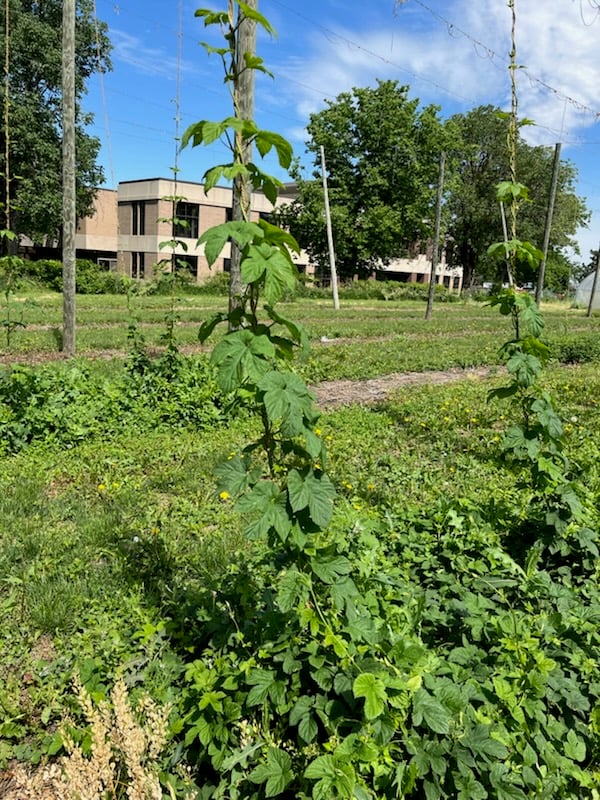
LINCOLN, Neb. (KLKN) – Most of the hops used in American beer come from the Pacific Northwest, but thanks to a hop-breeding program at the University of Nebraska-Lincoln, that may be changing.
Professor Keenan Amundsen says his love for horticulture developed from his desire to improve agriculture, so he founded the Amundsen Research Lab in 2016 to do just that.
One program within that lab is the Hop-Breeding program, which produces research that has become increasingly important as local breweries in Lincoln have risen over the last decade.
“And one of the interests of local craft brewers is that they want local ingredients for their beers. It sets their beers apart from others, has unique, distinct flavor profiles, aromas, those types of things,” said Amundsen.
His doctoral student, Kristina Alas, does much of the legwork within the Hop-breeding program.
“The main thing I do here in the greenhouse is just start our seed and grow out new genotypes for the following season,” said Alas.
Coincidentally, she had first wanted to study a different plant in the Amundsen lab, but after coming across an opening in the hop-breeding program, she was hooked and is now the lead researcher, and at many times, the only one.
Alas playfully described many of the plants there as her babies.
“I’m the only person in the program, I’m outside alone a lot, and so I feel like all my plants have a personality and I give them a name associated with their personality,” she said.
Alas discovered the heat-resistant hop, Margie, after it grew to be nearly 18 feet and fit the criteria the plant needs to survive in Nebraska.
After careful evaluation over the course of three years, she recognized its strength and named the hop after her dog, a pitbull-German Sheppard, seeing similarities between her pet and the plant.
“We looked at her vigor, how much she’s producing, so her yield, and now with Margie, we are growing her at different locations around Nebraska,” said Alas.
“We have a few hop producers such as Christensen Hop Farm, which is in Fort Calhoun, we have Skybound Hops in Dent, Nebraska, helping us evaluate Margie and a few of our other genotypes.”
She says different hop types have different flavors, and as for Margie?
“Margie is a pretty, floral, and earthy lady,” said Alas.
A taste that can be found at many local breweries, such as the Corn Coast Brewery in Lincoln.
Alas has also founded the “Big Red Brew Club” for students, which allows them to visit breweries. The group has also used Margie to create a German Pilsner.
Prof. Keenan adds that Margie is still in the developmental stage, and he hopes to continue working with local craft brewers and get some Nebraska hops in large-scale production in the state.