Rubio pledges US won’t take unilateral action against drug trafficking despite recent strikes
LIMA, Peru (AP) — Secretary of State Marco Rubio pledged Thursday that the U.S. would not take military action against narcotics traffickers in Latin American countries without the approval of its allies, even as the Trump administration keeps up a yearlong campaign of deadly strikes against alleged drug boats in international waters.
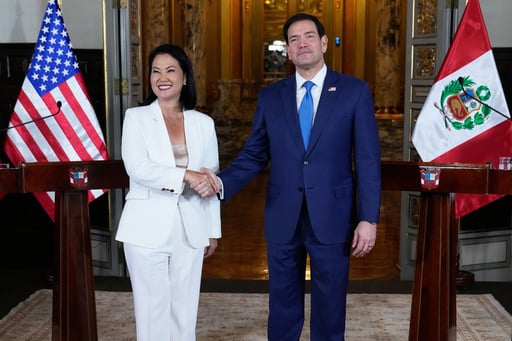
Standing next to new Peruvian President Keiko Fujimori, Rubio told reporters that while the U.S. has “the capacity to act unilaterally,” it would rather work with its allies because that is “the most effective way to do it.”
His comments came shortly after Fujimori announced that Peru had joined the “Shield of the Americas,” a U.S.-led coalition of like-minded countries in the region to carry out joint military operations against drug cartels. Colombia, where Rubio also stopped this week, also recently joined the group under new President Abelardo de la Espriella.
“We’re not going to do anything that our partners don’t ask us to do,” Rubio said Thursday. “We don’t want to do less than what you ask of us, but we’re not going to do more than what you ask of us.”
Rubio wraps up trip to visit Trump-friendly leaders in South America
During his fifth trip to Latin America to further cement the Trump administration’s security partnerships with conservative leaders, Rubio this week acknowledged an evolving U.S. strategy to combating drug trafficking in Latin American waters. He said the administration would be working with allied countries and aligning with their laws but also insisted the military will “still blow up ships if need be” and the approach would “a strike-by-strike or operation-by-operation determination.”
After his comments Wednesday, the U.S. military said it carried out another deadly strike against those it called “narcoterrorists” operating a boat in the Caribbean Sea, killing three people. Recently, the military has been carrying out joint operations mainly with Ecuador in its territorial waters, where people have been removed from vessels accused of aiding drug trafficking and transferred to Ecuadorian authorities.
Rubio also visited Colombia and Ecuador this week as part of a tour of Trump-friendly, conservative-led countries as the administration steps up its counternarcotics and immigration efforts throughout the Western Hemisphere. Reestablishing U.S. dominance in the region has been a priority for the Trump administration.
Fujimori said Thursday alongside Rubio that “a new era in relations between Peru and the United States is beginning.” She emphasized that Peru’s “sovereignty remains intact” and said the country would continue trading with nations in Asia and Europe.
Peru joins US coalition to fight drug trafficking in the Americas
Fujimori said Peru’s entry into the Shield of the Americas group “will allow us to obtain information more quickly and act decisively” against cross-border crime. She noted that the United States helped Peru combat drug trafficking in the 1990s, adding that “we have already shown what two countries can achieve by working together.”
Like her counterparts in Colombia and Ecuador, Fujimori has prioritized the fight against crime in Peru, especially crimes such as extortion and murder. Reports of extortion rose from 2,421 in 2019 to 26,734 in 2025, according to official data.
At the end of August, Peru declared a 60-day state of emergency in Lima and the port of Callao due to the rise in crime and created a committee of officials to coordinate the police. It also declared a state of emergency in five prisons, seeking to control access and prevent escapes.
Peru is one of the world’s leading producers of cocaine, according to the U.S. Drug Enforcement Administration. It is the second-largest cultivator of coca leaf — the raw material for cocaine — only after Colombia, according to the United Nations Office on Drugs and Crime.
Trump’s administration has put a focus on the Western Hemisphere even as it has launched a war against Iran. Trump has spoken numerous times of reinvoking the 19th-century Monroe Doctrine, asserting U.S. primacy in the Americas with a focus on drugs, migration and not least countering growing Chinese influence in the region.
The Chinese Embassy in Peru said Tuesday that the “Western Hemisphere is nobody’s ‘backyard,’” in a statement that did not name Rubio but was issued on the eve of his visit. China noted that Latin American countries have the “sovereign right to freely choose their partners” and expressed its willingness to work with Peru and other countries in the region.
Peru also has had a long history of dealing with left-wing insurgencies and still has a sizable number of people sympathetic to such causes.
As Rubio arrived in Lima late Wednesday, hundreds of people protested in Lima, chanting “Yankees out of Peru,” and members of the Communist Party waved red flags and a banner with Rubio’s face.
“Marco Rubio arrived in Peru today, and what he wants is for Peru to be his colony,” Carmen Espinoza told The Associated Press. “That’s why we’re here protesting, rejecting the visit of an enemy of Peru.”
The demonstration was peaceful and was monitored by police officers who sought to prevent any potential disturbances.
Soledad Lozano, one of the protesters, said Peru “is not the backyard of any country in the world” and argued that Peruvians should decide “with whom we ally ourselves and what agreements we make.”
Suarez reported from Bogota, Colombia. Associated Press writers Farnoush Amiri in New York and Meg Kinnard in Columbia, South Carolina, contributed to this report.